Tuesday, November 30, 2010

Cannons

So hard to find any background on this topic, so I did not find much helpful information beside the obvious...
There are few factors that I think will determine the effectiveness of the cannon.
First factor: Angle for the maximum range
In a hypothetical situation, suppose all other factors are controlled, including friction, air resistance, velocity, etc. And the only variables that are being altered is the launching angle of the cannon, how will the range of the cannon ball launched be affected? Or otherwise, what angle will give the biggest maximum range for this projectile motion of cannon?
Imagine launching at 30, 45 and 60.

It seems that the launch angle of 45 will result the farthest distance travelled. From what we learned in kinematics, range of a projectile motion will be determined by the product of hang time and Vx. For angle of 30, it had the biggest value for Vx out of the 3 cases, but it's maximum range was limited by its hangtime due to lack of Vy. For angle of 60, it had the biggest value for Vy. Therefore, its hangtime was the greatest out of all three, however, its maximum range was then limited by its Vx, the lowest of all 3. The angle of 45, which did not have the highest value in any categories, had the biggest maximum range because it had a decent value for both the hangtime and also Vx.


Tight Sealing:
For the duct tape that are used to stick together the pieces of pop can, it ensures that first of all, fuel does not leak when we shake the cannon, and secondly to make sure the no force/energy caused by the explosion "escape" from the launch. This is because we want the force caused by the explosion to focus on the "bullet", which would be the paper cup.

Mass of the base:
The mass should not be too light, because the force that causes the cannon ball to fly on its path will cause an equal force on the base of the cannon (opposite force, newton's 3rd law).This is why tanks and cannons are made out of metal as its for resisting the opposite force after launching.

In summary, what will make a better cannon? A combination of high hang time, initial horizontal velocity, little friction and built almost flawlessly.(Completely enclosed taping, a strong base and other factors)

Wednesday, November 24, 2010

Dynamics

Equilibrium
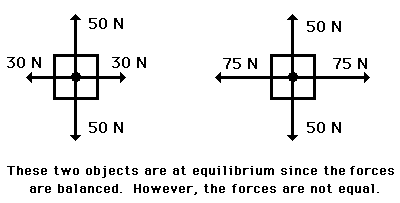
This is achieved when the forces of both x and y components are balanced. Therefore, we get an overall acceleration of 0, hence the object is at a state of rest.
Assumptions:
  • No Friction
  • No Acceleration
The forces in the y and x components of the object being acted on are balanced. Hence, we must find the x and y component of force that is acting on the object.This can be accomplished by using vectors component, when we know the force in N at a given angle.
For example:

Object B has a force of 9.2N acting on it at a angle of 70 degrees with the horizontal, therefore
Bx = 9.2 cos 70
By = 9.2 sin 70
With multiple forces acting on an object, add my x directions forces and y direction forces together to get Fnetx and Fnety.
The other forces acting on the object would be gravity. Since the forces are balanced and the object is not moving up and down, we can conclude that:

Fg = F net y, furthermore, we know that Fg = ma.
We already know that a is equal to 9.81m/s^2, therefore the mass of the object can be calculated by:
M = F nety / acceleration.
We can always check if our answer is right by calculating and see if the x direction forces are balanced as they're suppose to in an equilibrium.

Static Inclines 

Assumptions:
  • No acceleration
  • + tive axes in the direction acceleration
  • No air resistance
  • fs (static friction) = µ * Fn
  • Fn is perpendicular to the surface
Looking at diagram, we already know that there is no acceleration at all, therefore:
Fgx=fs, where Fgx = Mg sin θ => Mg sin θ = M Fn
Fn=Fgy, where Fgy = Mg cos θ => Mg cos θ = Fn (sub into first equation)
Mg sin θ = µ Mg cos θ
 µ = sinθ/cosθ
 µ = tanθ

Kinetic Incline
 In this case, the incline is almost like a static incline, except the object is moving and accelerating in the x direction. Therefore, ax does not = 0
Other assumptions:
  • No acceleration in y direction
  • + tive axes in the direction acceleration
  • No air resistance
  • fk (kinetic friction) = µk * Fn
  • Fn is perpendicular to the surface
In the x direction: 
Fgx - fk = ma, Mg sin θ- µFn = Ma (1)
In the y direction:
Fn - Fgy = 0 (since acceleration is still 0), Mg cos θ = Fn (2)
Sub (2) into (1)
Mg sin θ- µ Mg cos θ= Ma
a = Mg sin θ- µ Mg cos θ / M

Pulleys
Assumptions:
  • No friction from pulley, rope or any other materials in the system
  • no air resistance
  • Remember to draw multiple FBDs depending on situation
  • Always make acceleration the positive axes in all FBDs
  • T1=T2
  • acceleration of the system is the same
Notice in this sample pulley problem, the positive axes is different in both diagrams because acceleration is opposite in both due to Newton's 3rd law.


For m1:
F = ma
 
Fₓ = ma
Fₓ = 0

Fy = m1ay
m1g - T = m1a
T = m1g - m1a (1)

For m2:
F = ma

Fₓ = ma
Fₓ = 0

Fy = m2ay
T - m2g = m2a
T = m2a + m2g (2)

By comparing equation (1) and (2)
set (1)=(2)
m1g - m1a = m2a + m2g
m1g - m2g = m2a + m1a
m1g - m2g = a (m2 + m1)
(m1g - m2g) / (m2 + m1) = a

To Find T
Sub the value of a into equation 1 or 2 to get value for T

*sometimes pulley will not necessarily be parallel to each other, they could be perpendicular or at any angle

Trains:
Assumptions:
  • 1 FBD for acceleration of the whole system, where a is constant throughout the system
  • multiple FBDs depending for the number of tensions there are
  • ay = 0
  • no air resistance
  • weightless cables
  • + axes in direction of a

For system acceleration:
F = ma
Fₓ = ma
Fₐ - f = ma 
Fₐ - µmg = ma
aₓ = (Fₐ - µmg) / m
This acceleration will be same for all parts of the train. There's no acceleration in y component since we do not see the train going up and down. This is the same for all components of the train

For m1:
F = ma

Fₓ = m1a
Fₐ - T1 - f1 = m1a
Fₐ - T1 - µm1g = m1a   
T1 = Fₐ - µmg - m1a
Now there's a choice of using m3 or m2, but I think Mr. Chung said using m3 is suppose to be less likely to make a mistake. So for the sake of grade, we should stick with m3

For m3:
F = ma

Fy = m3ay
Fy = 0
Fn3 - m3g = 0
Fn3 = m3g
 
Fₓ = m3a
T2 - f3 = m3a
T2 = m3aₓ + f3
T2 = m3aₓ + µm3g

Saturday, November 6, 2010

Projectile Motion


Picture of Projectile With Vectors
Projectile Motion

A general summary of solving projectile motion problems, finding the usual things (Range, Height, hang time), without regard of air resistance.

Since all these problems occur on Earth, the acceleration of all the problems will be the gravity (-9.8m/s2)

However, gravity will only affect the vertical-y component, therefore the acceleration of horizontal speed is 0 - constant velocity (v1x = v2x = vx)

Components of original velocity:
Components of Original Velocity for Projectile


Using basic trignometry, we can calculate x and y components when given the inital velocity and angle.
X component of original velocity: vx1 = v cos(θ)
Y component of original velocity: vy1 = v sin(θ)
Height:
Velocity Vector at Top of Trajectory
At its maximum height, Vy becomes 0
Given vy2 = 0, vy1 = V1 sin θ, ay = -9.8m/s2
v22=v12+2ad
v22=v12+2aH
   0=v12-2gH
   H=v12/2g

Hang Time: After finding out  V1x and V1y with trignometry, we know that the displacment vertically is 0 after the total time.
Given : dy = 0, ay = -g
 d = v1t + 0.5at2
 0 = v1yt + 0.5(-g)t2
 v1yt -0.5gt2=0
 t(v1y-0.5gt)=0
Therefore, t = 0 or T = 2v1y/g
Range:
Range of Projectile
This is the distance the object travelled horizontally, since the horizontal velocity is constant, we can find out the distance from equation : 
Dx = (Vx)(T)

With reference to the time of the projectile, we can then easily calculate the range. 
(I prefer doing them one by one)


Different Types of Projectile Motion


Tuesday, November 2, 2010

The Physics behind Roller Coasters

Many people do not realize the force driven behind rolle coasters is not from electric energy, but potential and kinetic energy. The mechanism of roller coasters is all about the physics behind the energy from its motions.

Think about when you lift a textbook above the table, what is happening to the book? It's actually gaining potential energy because when the book is dropped at some point, the energy can be observed and heard when the book hits the table. This is all because another force - gravity, is acting on the object. Relate this observation to rollercoasters, the potential energy of the rollercoaster will be highest when it's at the highest peak of the rail, because more kinetic energy will be produced when it swoshes down the rail. Therefore, as the coaster travels lower and lower, it converts all of its potential energy into kinetic energy. So the potential energy is the lowest when its at a low altitude, but inversely, kinetic energy is the highest.

Modern roller coasters usually have a launcher, which gives it an extra push to begin with, building up more kinetic energy.We know that energy cannot be created or destroyed, rollercoasters work on the principles of the conversion of one form of energy into another. However, in theory, the train should be able to climb to its original height after the first drop (energy conversion). But dissipative forces such as friction and air resistance denies this possiblity. This is why the first peak for a rollercoast is always the highest in order for it to gain more potential energy.

Thursday, October 28, 2010

How to Add Vectors?

We know vectors differ from scalar because it not only has a magnitude, but also a direction. On a graph, we will assume that the positive directions for the y axis is north (up), and the positive direction for the x axis is east (right).Therefore, directions of south and west symbolize negative vectors.
Now for adding vectors on a graph. In most cases, there were be more than 1 or 2 vectors heading into all directions. If you are a great mathematician like Mr. Dulmage, you would say, "Oh, I can solve this trignonmetry, EASILY, because the you first get the sine of blah blah, and use that to get the cosine of blah blah..."
Confusing isn't it? Most of us aren't great mathematicians, or are at some extent.Therefore, a much simpler to calculate the resultant is to simply "add" all the x values and y values of vectors. (Note: in some cases when vector is negative, we're theoritically adding vectors, but adding by a negative digit is also the same as subtracting the number).
So next we'll have to figure out how to find the x and y values for the vectors on the graph to add.
In one case, if the vector's x and y values are given, that's great because you wouldn't need to worry about calculating them. But when they're not given, we'll use some trignometry we learned in grade 10 math to solve this problem.

Opposite side is the y value, adjacent side is the x value. With basic sin and cos laws, we would be able to calculate the x and y values.
So next as mentioned already, we add all the x and y values. But keep in mind that even when some times you're adding a vector, you have to be careful because the direction of the vector determine if the number is positive or negative.


 For the x axis, vectors with direction east are positive. Vice versa, vectors with direction west are negative. When considering only the x value for adding two vectors, if both vectors have direction east, you add the 2 numbers, if both have direction east, it would be (-x1)+(-x2), so theoritically adding 2 negative numbers. When one is east and one west, it will be one positive subtract one negative.
As demonstrated by the diagram, adding y values for the resultant y would be the same way.

Finall, now after all that, we get our resultant x and y values. But we're not done yet because we have to calculate the hypotenuse. We can do this with the help of Pythagora and his theorem.
So now we are able to calculate the hypotenuse with the derived formula x2 + y2 = R2, but we still have to know which direction specifically the vector is heading towards. This can be determined by going back to the x and y values for the resultant.Once again, positive y value means the vector is heading towards north, and vice versa. Positve x value means the vector is heading towards east, and vice versa.
So after we get these 2 directions, we can imagine a little triangle inside our head: If the vector start from the origin (0,0), by what degree have it gone east or west from south or north?
This can be again calculated from the help of trignometry. We know that the tan is calculated from opposite over adjacent, so now we just have to see the triangle in different views to see which value (x or y) is the opposite side and adjacent side. For this calculation, make sure that you're reading the angle from the y axis to the x axis with respect to where the vector is located.
And now finally, we write the resultant vector as: the hypotenuse value [ydirection (degree) xdirection]

If you're still confused because I know I didn't explain very well, check out this video - it MIGHT help you :)
http://www.youtube.com/watch?v=UmLu3HIKBG8

Wednesday, October 20, 2010

Deriving equations from the graph but flipped because I got my trapezoid backward, yah :)

When given the velocity graph, we already know that by calculating the area of the shape in respect of the x axis, we will get the displacement.
Generally, the shapes are rectangles, triangles and the combination of both - trapezoid.
We know that the formula for calculating the area for rectangle is:
A = LW,
and formula for triangle is:
A = 1/2 BH
and trapezoid:
A=(a+b)H/2
But sometimes, the trapezoid can also be seen as a triangle and rectangle stacked on top of each other. Therefore, another way of calculating the area of the trapezoid can be: Area of triangle + Area of Rectangle
A = LW + 1/2BH
In this sketch I drew on paint (:, the graph is a typical velocity time graph. As ou can see, the trapezoid is divided into 2 parts - a triangle and a rectangle.
So first, the base of triangle as we can see, is time(t), the height is the difference between v1 and v2. So the area of the triangle is:
A = 1/2(t)(v1 - v2)
For the area of the rectangle, obviously the length is t, and the width is v2, so the area is:
A = v2 * t
By adding the sum of these areas, we get the area of the trapezoid, or otherwise as we know the displacement:
D = 1/2(t)(v1 - v2)+v2*t (2)
Now from previous knowledge, we already have equation 1):
v2=v1+at (1) => v1=v2-at (3)
Sub (3) into (2):
D=1/2t(v2-at-v2)+v2*t
D=(v2)(t)+1/2at² 
And Voila! Equation 3 from the Big Five!
To derive equation 4, the idea is about the same, except this time, you look at the graph a little differently

You treat the trapezoid as a bigger rectangle, but without the shaped triangle. So another way to calculate its area is by calculating the area of the rectangle, and subtract the area of the imaginary triangle from it:
A = LW - 1/2(BH)
First, the length of the rectangle as we can see is t, the width is v1:
Area of Rectangle: v1 * t
Secondly, the base of the triangle is again t, the base as you can see by observing more closely, is (v1-v2).
Area of Triangle: 1/2(t) * (v1-v2)
Therefore, area of trapezoid: v1 * t - 1/2(t) * (v1-v2) (1)
Once again we apply the first equation that we already know of:
v2 = v1 + at (2)
Sub (2) into (1)
D = v1 * t - 1/2(t) * (v1 - v1 - at)
D = (v1)(t) - 1/2at²
And Ta da! Equation 4!
(Please note that v2 and v1 in the equations are opposite of the ones in the textbook, this is because the longer and shorter side of the trapezoid I have is directly opposite of the ones we did in class)

Tuesday, October 12, 2010


  • This is a distance and time graph.
  • When line is constant, it represents immobility, so we stay at one spot.
  • When the line has a postive or inclining slope, it means moving East, in this case away from the sensor
  • When the line has a negative or declining slope, it means moving towards the opposite of East - West, in this case towards the sensor.   
1. Stay at 1m for 1 second.
2. Walk 1.5m in 2 seconds (0.75 m/s) east.
3. Stay at 2.5m for 3 seconds.
4. Walk 0.75m in 1.5 seconds (0.5 m/s) west.
5. Stay at 1.75m for 2.5 s.
    • This is also a distance and time graph
    • Alike the first graph,line of + slope means moving East and away from the sensor.
    • Vice versa, line of - slope means moving West and toward the sensor.
    1. Walk from 3m east away from origin west at 1.5m in 3 s (0.5 m/s)
    2. Stay at 1.5m for 1 s.
    3. Walk west at 1m in 1 second (1.0m/s).
    4. Stay at 0.5m for 2 s.
    5. Walk east at 2.5m in 3 seconds (0.83 m/s)
     
    • Different from the first two graphs, this is a velocity time graph.
    • When the line is at 0, it means 0 velocity thus unmoving.
    • When line is constant and +(above 0), it represents a constant velocity moving East (away from the sensor)
    • When line is constant and -(below 0), it represents a constant velocity moving West (toward the sensor)
    1. Stay for 2 seconds.
    2. Walk east at 0.5 m/s for 3 seconds
    3. Stay still for 2 seconds.
    4. Walk west at 0.5 m/s for 3 seconds.


    • This is also a velocity and time graph
    • Alike the previous graph, line at 0 means 0 velocity (unmoving), constant line above or below zero means moving in East or West directions
    • When line is linear (with a slope) and constant, it means a constant but gradual increase in velocity. To walk this, we have to gradually speed up in the time span
    1. Run and accelerate east at 0.5 m/s in 4 seconds.
    2. Walking east at 0.5 m/s for 2 seconds.
    3. Walk west at 0.4 m/s for 3 seconds.
    4. Stay still for 1 second.
     
    • This is a distance and time graph
    • Alike graph 1 & 2, line of + slope means moving east constantly. (vice versa for negative slope)
    • Line of constant (horizontal line) represents 0 distance in a time span, thus 0 velocity. 
    1. Walk east from 0.8m east of origin at 1m in 3.5s (0.29 m/s)
    2. Stay still at 1.8m for 3.25 s.
    3. Walk east at 1.4m in 2.25 s (0.62 m/s)
     
    • This is a velocity and time graph
    • line of constant and positive represents a constant velocity moving East (away from the sensor)
    • Line of constant and negative represents a constant velocity moving West (toward the sensor)
    • Sudden increase or decrease in the value of the line means a dramatic acceleration or slow down
    1. Walk east at 0.35 m/s for 3 seconds.
    2. Walk west 0.35 m/s for 3.5 seconds.
    3. Stay still for 3.5 seconds.